
Israeli firm Cognyte sells phone-tracking gear to US police departments with a record of enabling authoritarian surveillance abroad
Contracts show Florida, Albuquerque, Baltimore, Washington, New York, and Texas police bought cell-site simulators from a company whose predecessor was accused of arming repressive governments.
Source: Responsible Statecraft · published August 28, 2026
Since 2022, at least six American police departments have signed contracts with Cognyte Solutions LP, an Israeli company that sells cell-site simulators capable of intercepting calls, messages, and app data from every phone in range.
The Florida Department of Law Enforcement bought Cognyte hardware in 2022 to track the phones of Haitian refugees, with a follow-up contract finalized in 2024, according to Responsible Statecraft's reporting. Albuquerque police made Cognyte their sole cell-site simulator vendor. Baltimore police list the company as a technology vendor, though the contract appears to have lapsed in 2023. The Washington Metropolitan Police Department signed with Cognyte in November 2025, the NYPD in December 2025, and Texas state police in March 2026.
Cell-site simulators work by mimicking a cell tower. A phone's connection algorithm is tricked into linking to the device instead of a real tower, giving the operator access to unencrypted calls, texts, and, on newer models, 5G and Wi-Fi traffic including app usage and browsing. The Electronic Frontier Foundation has documented the technology in more than 80 US police departments and has tied it to warrantless, covert searches.
Cognyte's origin traces to Verint Technologies, another Israeli firm. A 2018 Haaretz investigation reported that Verint's cell-site simulator technology had been used by Azerbaijan and Indonesia to target LGBTQ+ citizens, by South Sudan to monitor regime opponents, by Bahrain in the imprisonment of a prominent human rights activist, and by police in Bogotá to surveil political demonstrators. Verint spun off its security division as Cognyte a year later, in December 2019.
In 2020, according to documents published by a Burmese human rights group, Cognyte sold its FalcoNet simulator software to Myanmar's military shortly before its coup. A subsequent State Department report found the regime's communications surveillance had helped enable extrajudicial killings, arbitrary detention, and torture. The report did not name Cognyte, but the company was one of only two major surveillance-for-hire firms known to have done business with the Burmese armed forces at the time.
Asked about its own use of the technology, Texas state police told Responsible Statecraft the equipment is used solely for search and rescue. Other departments named in the reporting did not respond to requests for comment.
"According to the group, it has played a role in a wide array of covert, warrantless searches."
Israel's surveillance sector is unusually dense, with Responsible Statecraft citing a claim that roughly 80 percent of founders in the country's homeland security industry passed through Unit 8200, the military's signals intelligence branch, before entering private business. That pipeline, and the contracts now spreading across American police departments, sit largely outside the public oversight debates that have targeted domestic tools like Flock license-plate cameras or Ring doorbell data-sharing.
Sources & Documentation
- This creepy Israeli spy tech is likely operating in a city near you — Responsible Statecraft
Related Coverage

JINSA Takes Credit for NDAA Provision Binding US Military Programs to Israel, Discloses Retired-General Pipeline
JINSA claims credit for an NDAA provision locking U.S.-Israel weapons cooperation, and most retired generals in its flagship program later joined the defense industry.

HSBC's 'Sharia-Compliant' Fund Bought $100M-Plus in Shares of Firms Supplying Israel's Military
HSBC's halal-marketed fund bought over $100m in shares of RTX, Analog Devices, Honeywell, Rolls-Royce and Palantir, firms tied to Israeli military supply chains, a Middle East Eye analysis found.
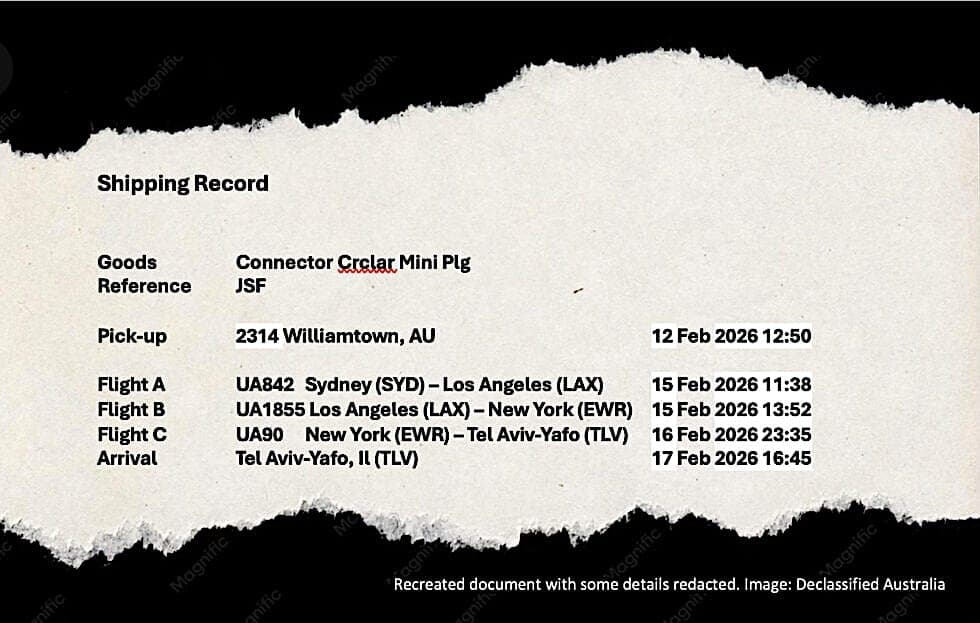
Leaked Records Show Australian F-35 Parts Now Flying to Israel on United Airlines Passenger Jets
Leaked shipping records show Australian F-35 jet parts, including a cannon gasket, are being routed to Israel via United Airlines passenger flights through the U.S.