
Israeli Army Barrier Project Cuts Water to 47 Jordan Valley Families, Residents Say
Villagers in Atouf describe six days without water, filled-in wells and a new 22-kilometer separation route they say is designed to force them off Area C land.
Source: The New Arab · published August 22, 2026
For six days, Lutfi Saeed Jabr and the families of his four sons have had no running water. The 70-year-old lives at the eastern edge of Atouf village in the northern Jordan Valley, on land he says his family has held since his grandparents' time, with documents to prove it. He told The New Arab that a newly built concrete wall and iron gates now separate roughly 20 families in the area from the rest of the village, while another 27 families about three kilometers away describe the same conditions. Together the two groups amount to more than 300 people.
Jabr said he owns around 700 sheep and greenhouses growing vegetables, wheat and barley, the family's only livelihood. He fears that leaving to fetch water or food could mean losing the right to return.
"Certain death or displacement," Jabr said of what cutting off the water means for his family, adding that he will not accept it.
He said the land sits in Area C, the roughly 60 percent of the West Bank under full Israeli military and civil control since the Oslo Accords, and that armed settlers enter the area nightly, threatening to burn homes, damaging water pipes and blocking roads, according to his account.
Abdullah Basharat, head of the Atouf village council, connected the water cutoff to a separation barrier the Israeli army announced roughly a year ago, which he called the "Crimson Thread." He described a planned 22-kilometer route running from Ein Shibli to the Tayasir checkpoint, cutting through farmland belonging to Khirbet Atouf, Ras al-Ahmar and other communities in the Tubas and Tammun areas, including orchards, greenhouses, wells and irrigation networks. Basharat said the barrier could isolate Palestinians from roughly 50,000 dunams of land.
He said digging for the barrier began in March 2026 and has since uprooted hundreds of trees and destroyed crops, greenhouses and kilometers of pipelines. Israeli authorities, he said, destroyed the area's main water pipelines and then filled in three working artesian wells without warning, a move he called a "knockout blow to irrigated agriculture in the plain" that cut water to about 4,500 dunams of grapes, olives and bananas.
Farmer Abdullah Bani Odeh, also among those facing expulsion pressure, described the situation as "catastrophic," saying Israeli authorities restrict access to grazing land his family has used for decades. "It is not simply land being taken from us," he said. "It is our lives being taken from us."
The New Arab's account rests on named residents and the village council head; no Israeli military statement, photographs or independent verification of the water cutoff, well destruction or barrier route accompanied the report.
Further Documentation
Sources & Documentation
- Hundreds of Palestinians under Israeli siege in Jordan Valley — The New ArabPrimary source; quotes from Lutfi Saeed Jabr, Abdullah Basharat and Abdullah Bani Odeh
Related Coverage
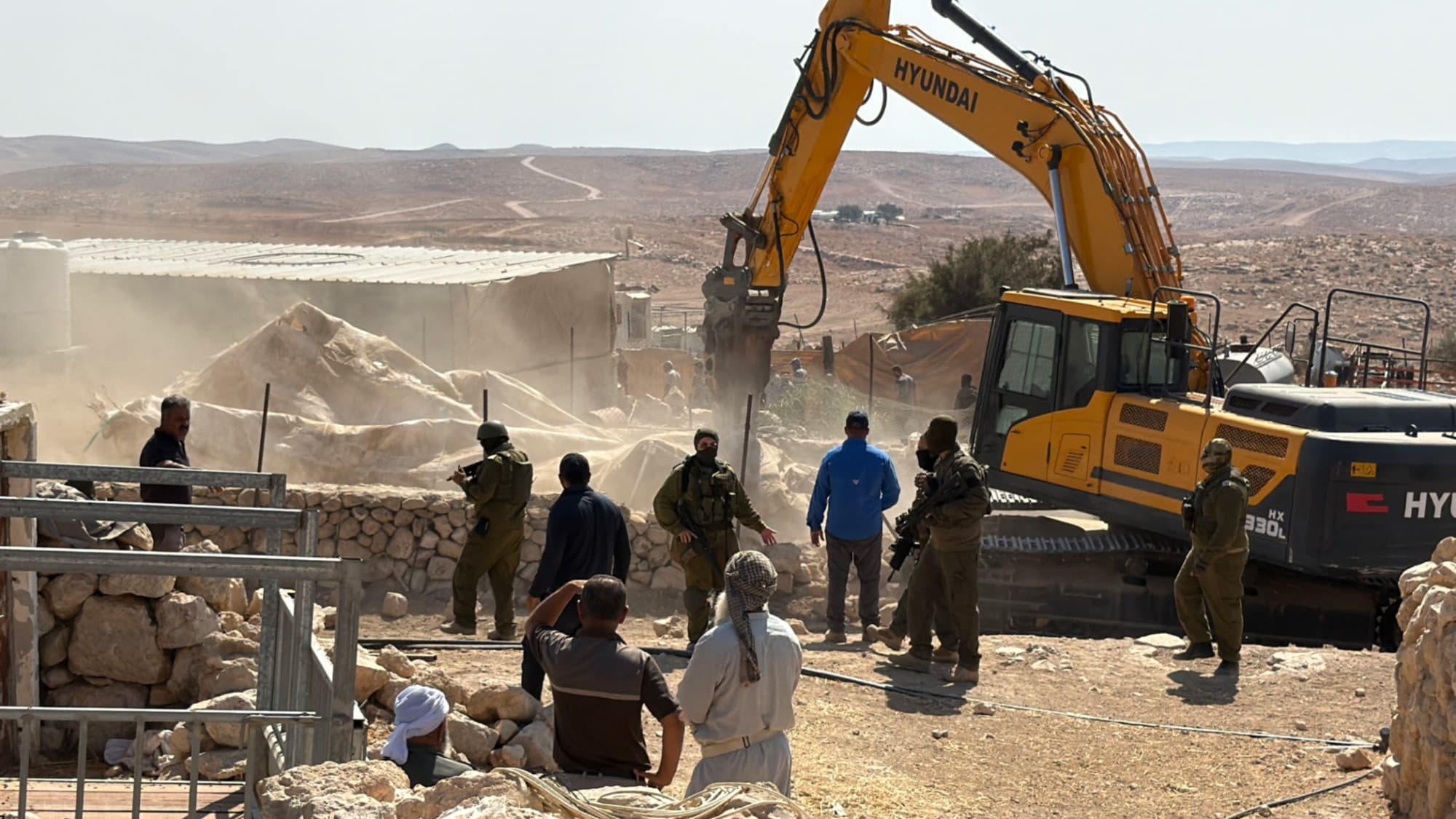
Israeli Forces Demolish 24 Homes in Janba, Displace 176 in Masafer Yatta
Israeli bulldozers razed 24 homes and sealed caves in Janba, Masafer Yatta, displacing 176 Palestinians including 85 children, B'Tselem reports.

Israeli Forces Kill Palestinian at West Bank Checkpoint After Car-Ramming Wounds US Ambassador's Son
Israeli forces shot dead a 29-year-old Palestinian near Ramallah after a car-ramming wounded the son of Israel's US ambassador; his body was reportedly withheld.

Israel Closes West Bank Crossings for a Week as UN Records More Than 300 Checkpoints Territory-Wide
Israel sealed the West Bank for Sukkot, tightening a checkpoint network the UN counts at over 300 sites among 925 obstacles restricting 3.4 million Palestinians.